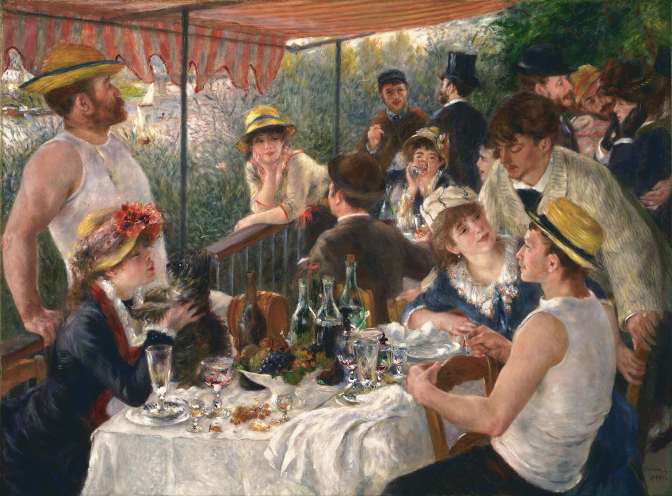
Luncheon of the Boating Party by Renoir, 1881.
An OSR campaign idea: A pseudo-Victorian / Edwardian society, a newly fashionable seaside resort. Coast on the west, wide and romantically desolate mudflats to the east. In summer, the fashionable gentry (the players) flock to the hotels and boulevards. Near the end of the season an aether storm struck and the train line home has sunk into the ooze. Now you are all overwintering in the cold and spray-splashed streets.
Various activities – dancing, reading, cold sea swimming, shell collecting – are employed to pass the stormy season, but soon a mania for archaeology/tomb robbing grips you all. Fueled by an collection of manuscripts left by a gentleman who died some years ago, you investigate maps of island ruins and barrows in the mudflats. Soon, this is augmented by ghost stories and rumours of pirate treasures extracted from the common folk.
Characters
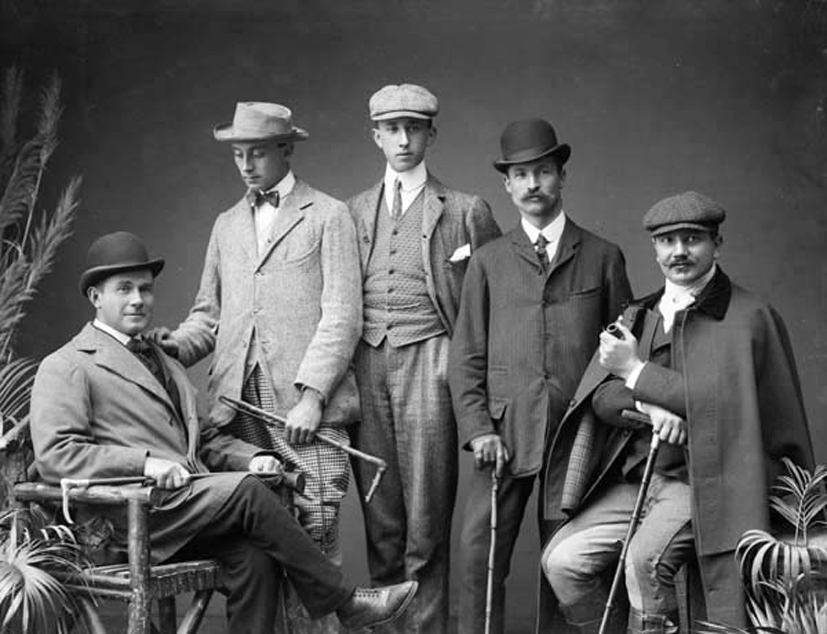 Imperial Hotel, The Mall, Waterford, September 8, 1903
Characters have a frivolity score, which is the extent to which they fashionably insist on treating everything as a marvellous jape and an excuse to make witticisms.
Frivolity is rolled to impress people at the end of an adventure, at the next meeting of the society: this is what grants XP. And you can also use it to make light of horrors when exposed. But conversely, low frivolity (high sobriety) allows you to prepare better for the next expedition: it determines how much of downtime is “wasted” in pleasure-seeking, dissipation, &c.
The unseen world & the world war
Gremlins, boggarts, fairies and shrieks: Monsters have always lurked in dark, in the forests, in the bogs. The empire has pushed them back and back, until many city dwellers in Europa believe them no more than old wives’ tales.
Then with the industrial revolution came blasting powder and man’s insatiable hunger for coal. But we delved too deep and broke the barrier between our world and one far more dangerous. The old creatures surged back, and new terrors emerged.
A total war ensued, humanity vs the horrors, that raged for 15 years. The Brittanic Empire’s modern weapons were of limited use. Many of the empire’s conquered peoples had magical traditions that were far more help. The British were first forced to rely on ‘native’ help, which led then to respect and, over the course of the war, relinquishing most the empire. In the younger generation, at least, this humbling experience has resulted in a seachange in racial attitudes.
Many of the characters’ frivilous exteriors are a response to their service experience. But beneath it they harbour deadly competence.
_by_Jules_David_(Ch%C3%A2teau_de_Compi%C3%A8gne).jpg) “Her Majesty Empress Eugénie dressed as an amazon (in riding dress)” by Jules David
“Her Majesty Empress Eugénie dressed as an amazon (in riding dress)” by Jules David
Meanwhile, the monsters that were not slain have fled into the uninhabited nooks and crevices of the world – including the romantically remote coast of England.
Gender
You could just construct a Victorian-themed world with total gender equality, and if that’s what you’re in the mood for, go for it. (Ditto, the previous section is an attempt to have a less rascist and colonial setting without just imagining the British as shining heroes – they’ve had to be forced into enlightenment. But again, you could just handwave all that).
An alternative approach: only women can use magic. For most of history magic has been a poorly understood science and most practitioners never rose above minor cantrips and charms. The rare exception were mighty sorceresses who terrified and conquered, but they were unable to pass on their understanding of magic. It is only in the last century, as the scientific method has made sense of chemistry and physics, that similar strides have been made in magic. Suddenly the old fashioned ‘women’s talent’ has become a powerful and rapidly advancing tool and is reshaping everything, including warfare and women’s role in it.
In other words: all wizards wear dresses. For now.